

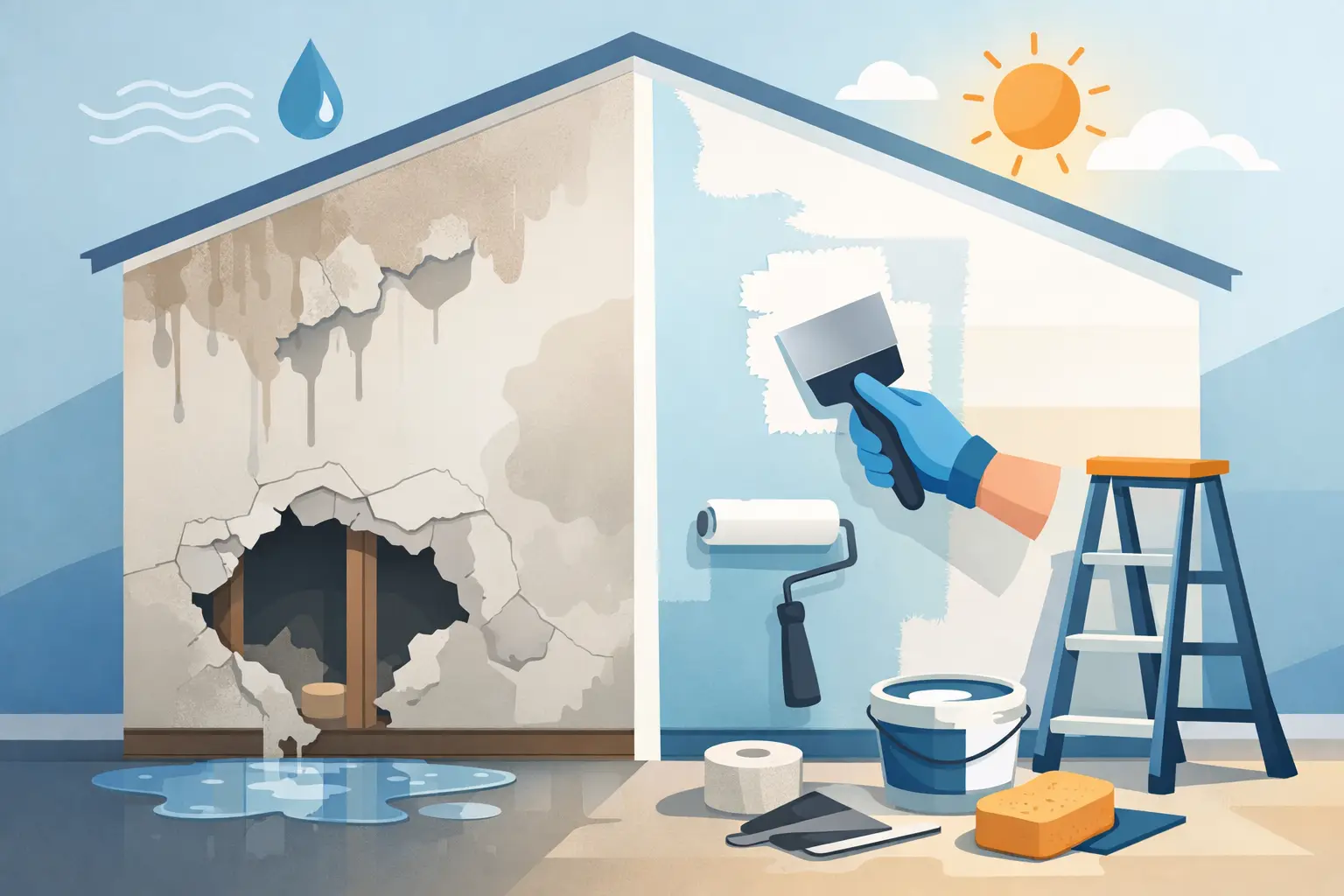
A wet ceiling stain or a soft patch of wall is rarely just a cosmetic problem. Drywall repair after water damage has to start with one question: is the material still structurally sound, or has moisture already moved deeper into the wall cavity, insulation, and framing? If that question is missed, a simple repair can turn into recurring stains, odours, and mould growth.
Why drywall fails so quickly after water exposure
Drywall is not forgiving once it gets saturated. Its gypsum core absorbs water, the paper facing traps moisture, and both lose strength fast. In minor cases, you may only see bubbling paint, taped joints separating, or shallow staining. In heavier events such as burst pipes, roof leaks, appliance overflows, or flooded basements, the board can swell, sag, crumble, or support microbial growth within a short time.
That is why timing matters. The visible stain is often the least serious part of the problem. Water can travel laterally, wick upward, and settle behind baseboards or inside insulated cavities. By the time drywall looks damaged, hidden moisture may already be affecting nearby materials.
Drywall repair after water damage or full replacement?
This is where experience matters. Not every wet wall needs to be torn out, but not every damaged panel can be saved either. The right approach depends on the source of water, how long the area stayed wet, how much saturation occurred, and whether contamination is involved.
When repair may be enough
Repair is often possible when the water source was clean, the exposure was limited, and drying started quickly. A small supply-line leak caught early may leave a localised stain or a minor soft area without compromising the full sheet. If moisture readings confirm the surrounding material is dry and the board has not lost integrity, the damaged section can sometimes be cut out, patched, retaped, sanded, primed, and repainted.
This works best when the paper face remains intact over most of the panel and there is no warping, sagging, or musty odour. Cosmetic damage alone is not always a replacement job.
When replacement is the safer choice
Replacement is usually the better decision when drywall has swollen, sagged, delaminated, or remained wet for too long. The same applies after sewage backups, storm flooding, or any incident involving contaminated water. In those cases, keeping the board creates unnecessary risk.
Ceilings deserve extra caution. Once overhead drywall softens, it can lose load-bearing strength and become a safety hazard. In basements and lower wall sections, water often wicks higher than expected, so the visibly damaged line may not show the full extent of saturation.
It also depends on what is behind the wall. If insulation is wet, framing is damp, or mould has started inside the cavity, patching the face of the wall is not a real fix.
The steps behind proper drywall restoration
Homeowners and property managers are often told to “just let it dry,” but that advice is incomplete. Effective restoration follows a sequence. Skip one step, and the repair can fail.
1. Stop the source and assess the category of water
Before any drywall work begins, the water source has to be identified and stopped. A leaking pipe, roof failure, condensation issue, appliance line, or plumbing overflow all change the scope of work. Clean water from a fresh supply line is treated very differently from grey or black water events.
If the source is contaminated, affected drywall is typically removed rather than repaired. Safety comes first.
2. Inspect beyond the visible damage
A proper inspection does not end at the stain. Moisture meters, thermal imaging, and cavity checks help determine how far the water travelled. This is especially important in condos, commercial units, and finished basements where leaks may spread through multiple assemblies before surfacing.
Without moisture mapping, repair decisions are just guesswork.
3. Remove unsalvageable materials
If drywall is no longer stable or sanitary, it should be cut out cleanly to a practical height or boundary. Baseboards, trim, insulation, and affected finishes may also need removal. The goal is not demolition for its own sake. It is controlled removal that creates access for drying and prevents hidden deterioration from remaining trapped.
4. Dry the structure completely
This is the stage that separates emergency restoration from basic handyman work. Air movers, dehumidifiers, and targeted drying methods are used to bring framing, cavities, and adjacent materials back to acceptable moisture levels. The timeline depends on the severity of loss, the materials involved, and indoor conditions.
Closing the wall too early is one of the most common mistakes after water incidents.
5. Sanitize if needed and verify conditions
Where there is contamination or microbial concern, cleaning and antimicrobial treatment may be required. Even in clean-water losses, musty odours or prolonged dampness can point to a mould risk that needs to be addressed before reconstruction begins.
Verification matters here. Dry means measured dry, not surface dry to the touch.
6. Rebuild the wall properly
Once the area is confirmed dry and safe, reconstruction can begin. That may include new drywall installation, taping, mudding, sanding, texture matching, priming, and painting. In higher-end homes, offices, and common areas, finish quality matters as much as structural correction. A rushed patch often flashes through the paint or leaves a visible seam.
The mould issue most property owners underestimate
Drywall repair after water damage is often delayed because the wall “doesn’t look that bad.” That delay is exactly how hidden mould problems start. Paper-faced drywall gives mould an organic surface to colonise once moisture lingers. In a humid basement, behind cabinetry, or inside an exterior wall, that growth can begin before there is any obvious discolouration on the finished side.
This does not mean every wet wall is a mould job. It means the window for safe drying is limited. Fast response reduces the chance that a simple leak becomes a remediation project.
For property managers and commercial operators, that risk is not only structural. It can affect tenant complaints, indoor air quality concerns, insurance documentation, and operational downtime.
What DIY gets right – and where it usually goes wrong
Some minor drywall repairs are reasonable for a skilled owner, especially when the damage is clearly cosmetic and the area has already been verified dry. Small cut-and-patch work after a contained clean-water event can be straightforward.
The problem is that many water-damaged walls appear smaller than they are. DIY repairs often focus on staining and surface texture while missing wet insulation, damp studs, or moisture trapped behind vapour barriers. Another common issue is repainting too early. Stain-blocking primer helps with appearance, but it does nothing for concealed moisture.
There is also a practical trade-off. If the wall needs drying equipment, contamination control, mould assessment, or insurance-friendly documentation, a basic patch repair is no longer the main task.
Special cases: ceilings, condos, and basements
Ceiling drywall should be treated carefully after leaks from bathrooms, roof penetrations, or upper-floor plumbing. Sagging sections can fail suddenly, and insulation above the ceiling can hold moisture long after the visible surface begins to dry.
In condos, the repair scope often extends beyond the unit where the damage appears. Water can travel from neighbouring suites, risers, fan coil units, or common building systems. Drywall repair may need coordination with management, trades, and insurers.
Basements across Toronto and the GTA create their own challenges because lower walls, flooring edges, and concealed cavities are more vulnerable to lingering dampness. After a flood or seepage event, lower drywall cuts are often necessary even when only the bottom portion looks affected.
How to know you are getting the right response
A credible restoration plan should explain why the drywall can be repaired or why it needs replacement. It should account for moisture readings, drying strategy, contamination level, and final reconstruction. If the conversation jumps straight to patching and painting without discussing what is behind the wall, that is a warning sign.
For urgent losses, speed still matters. The first 24 to 48 hours can change whether the job stays a controlled repair or expands into a larger remediation issue. That is why companies like CPR24 Restoration treat water-damaged drywall as part of a full drying and recovery process, not as an isolated cosmetic fix.
If your wall or ceiling has taken on water, the smartest next step is not to wait for the stain to “settle.” It is to confirm what is wet, what can be saved, and what needs to come out before a minor repair becomes a bigger property problem.